

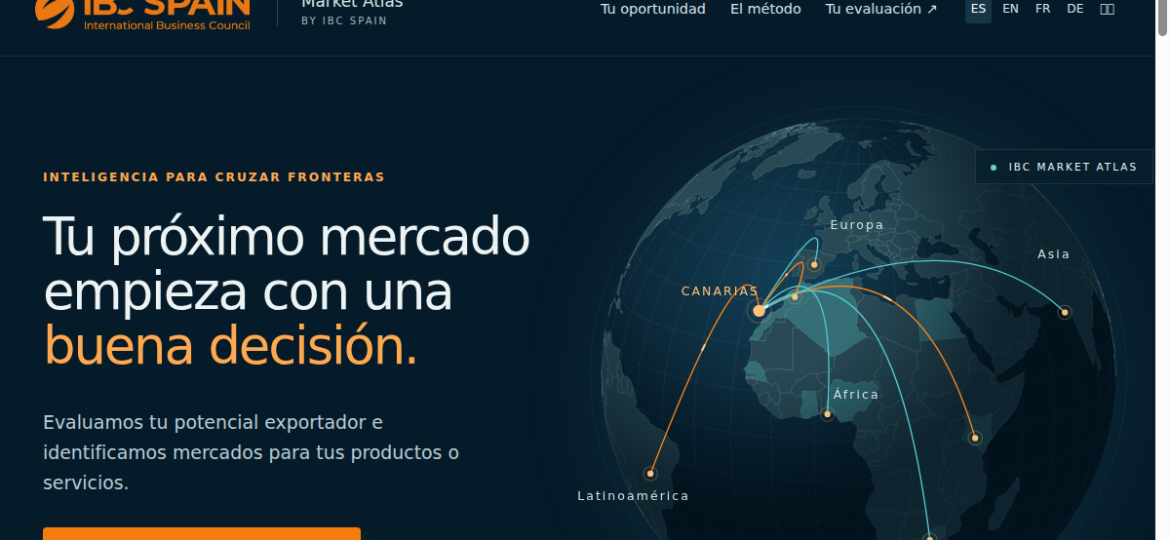
We are launching IBC Market Atlas, the market intelligence tool we have been building for months and already use in our working sessions with companies. It lives on its own site, ibcmarketatlas.com, and from today it also has its page on this website.
The problem it tries to solve
Choosing a market is one of the most expensive decisions an exporting company makes, and it is almost always made with less information than it deserves: because of a trade fair someone attended, a contact who turned up, a country that sounds promising. When the choice is wrong, the cost is not the market study that was never commissioned: it is the two years of commercial effort spent in the wrong place.
The Atlas brings together foreign trade, foreign direct investment and economic, logistics and risk context in a comparable view, drawing on official, cross-checked sources. Every figure keeps its source, its unit and its period.
Two ways to use it
With your company. We offer a free initial assessment: a 30 to 45 minute session in Spanish, English or French where we start from what you sell, to whom and with which resources, explore markets with you and separate facts from hypotheses. Afterwards you receive an initial report reviewed by the team. It works for products and for services, which call for different questions.
With chambers, agencies and associations. The same Atlas works as the basis for workshops in front of an audience, for individual diagnoses and for support programmes with an agreed cohort, deliverables and evaluation criteria. There is an institutional proposal with three scopes, a guided video tour and a downloadable dossier (in Spanish).
What the Atlas does not do
This deserves to be said as plainly as the rest. The Atlas is not a crystal ball or a customer finder: it does not identify specific buyers, it does not validate a product on the ground and it does not guarantee sales. Statistical coverage is uneven across countries and indicators, customs statistics for goods are not a proxy for demand for services, and missing data is not a zero. All of that is said in the session and written into the report.
Nor is it a dashboard you subscribe to: it is a private tool the IBC team uses with you. The data frames the question; interpreting it is our job and the decision remains yours.
And Africa in particular
The context invites a closer look. The WTO reports a 15 % year-on-year increase in the US dollar value of African merchandise imports in the first quarter of 2026, while UNCTAD puts foreign direct investment received by the continent in 2025 at around 70 billion dollars, 26 % less than the previous year. These are regional magnitudes, not sales forecasts: Africa is not a single market and the opportunity depends on the country, the sector and your company. Which is precisely why you should compare before deciding.
How to start
The initial assessment is free and commits you to nothing. Request it at ibcmarketatlas.com or write to us if you would rather talk it through first.